
Version 2.18

  • Albeit the 2.17 release was just a couple weeks ago, I’ve been quite busy with further improvements – and things looks pretty stable at this point in time.
    Therefore – and should I get eaten by a crocodile (or bombed by Trump) anytime soon – an even newer, even better ASIO4ALL – here and now!
  • This version officially supports Windows 10 and Windows 11.
  • Also confirmed to work with Windows 7 and Windows 8, with some minor GUI visual artefacts, though.
  • Report bugs to feedback@asio4all.com!

Changes since version 2.17

  • No longer crashes after USB audio device surprise removal. The expected behavior is to attempt a reconnect and resume audio streaming. Having your USB audio interface connected to a KVM switch, changing between computers – with ASIO4ALL currently active on both – should result in a graceful handover in either direction.
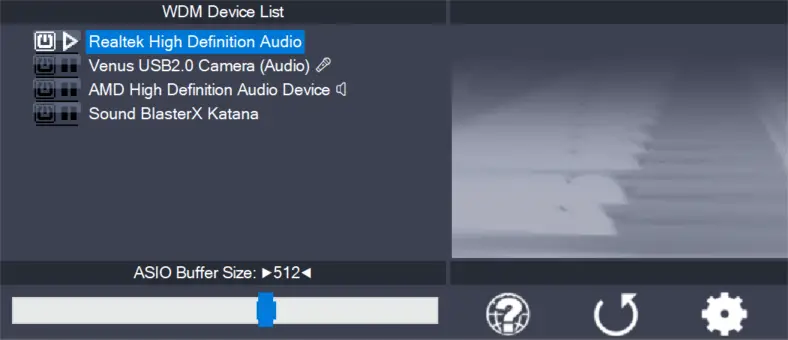
  • Some more work went into accurate audio buffer synchronization. The “Buffer Offset” slider is about to become phased out. If your setup absolutely requires a non-default position, I’d be interested to learn about it! (Except when trying to “fix” sample clock drift issues this way…)
  • Fix unexpected behavior (including crash) when host tried to set a new sample rate.
  • Good old plain Azalia WaveRt devices will no longer have their position register ignored despite a returned accuracy of “0”.
  • Further improve input/output latency reporting.
  • The “Debug” option has been debugged and will better assist debugging whenever there is something to debug.
  • In preparation of the upcoming device audio clock drift correction (yes!), ASIO4ALL can now measure and display the actual sample frequencies of individual devices, either directly or inside the tooltip window when hovering over. This shall help finding out wether individual device clocks are synchronized or not. Since the system clock serves as a reference clock, measurement results always are only relative, never absolute! Accuracy will improve with run time. Give it at least 5-10 minutes for a useful reading!


Posted

in

,

by

Tags:

Comments

18 responses to “Version 2.18”

  1. Hi there,
    I found a bug in ASIO4ALL.218: after changing the selected device in the device list, the audio gets stuck in an infinite play/pause loop and stops working properly. The only fix is to restart the DAW entirely.
    Could you please look into this issue?
    Thanks

    1. fter changing the selected device in the device list, ASIO4ALL itself gets stuck in an infinite start/stop loop and audio stops working properly.

    2. This issue usually occurs when a WaveRT device is not selected for both input and output simultaneously, or when using a USB audio device such as the CM108. ASIO4ALL will repeatedly toggle between play and pause infinitely.

    3. I have also discovered an alternative workaround for this infinite play/pause state: after changing the device list, if there is no WaveRT device enabled in the list, simply select one WaveRT device and then deselect it immediately. After doing this, the infinite loop stops and ASIO4ALL returns to normal.

    4. after changing the device list, make the DAW fully disconnect from ASIO4ALL so that the ASIO4ALL tray icon disappears completely. Then reload and re-enable ASIO4ALL in the DAW again. After doing this, it will start successfully and work normally again.

    5. Could you please run the trace build on the issue, so we can figure out what’s happening? https://asio4all.org/debug-build-with-trace-output/

      1. Author: Michael Tippach
        Description: Official debug log for ASIO4ALL, a universal ASIO driver for Windows audio devices.
        https://share.note.youdao.com/s/1cxBmbMp

        1. Hi, this is the debug log from ASIO4ALL. Thanks for your great work! IM SO SORRY

        2. Could you please send this per email (feedback@asio4all.com)? Thanks!

          1. Michael Tippach Avatar
            Michael Tippach

            Found the root cause, thanks to KJ. For those needing a fix urgently:
            https://asio4all.org/downloads/ASIO4ALL_2_19_Test.exe

          2. The developer of ASIO4ALL v2.19 Development Preview is No problem. The author information is fully confirmed.

  2. Tarek Hasan Avatar
    Tarek Hasan

    Hi, thank you for your work.

    I don’t know if you heard about this, on October 15, 2025 Steinberg made ASIO open-source under dual license (GPLv3 and Proprietary). So you can change the licensing of the software, if you want.

    Also, July 2023 Steinberg released “[built-in ASIO Driver](https://helpcenter.steinberg.de/hc/en-us/articles/17863730844946-Steinberg-built-in-ASIO-Driver-information-download)” which will replace their Generic Low Latency ASIO Driver.

    Hope these infos help you anyway.

    1. Michael Tippach Avatar
      Michael Tippach

      The Steinberg ASIO driver is using WASAPI Low Latency Shared Mode. Giving you the advantage of being able to use more than one audio application at a time – but at the expense of a slightly higher latency.

      You can compare yourself, using an audio loopback:
      https://asio4all.org/latency-compensation/

  3. Works now better than my old native soundcard ASIO driver. Thanks a lot for your work.

  4. Audio cuts out whenever I play sound from a web browser on Twitter while FL Studio is running with the ASIO driver. This only happens when Chrome is using the Intel GPU’s HD Audio (Display Audio) output to my monitor.

    1. Michael Tippach Avatar
      Michael Tippach

      You can use LatencyMon to narrow down the root cause: https://www.resplendence.com/main

      Other critical things to check for:
      https://asio4all.org/introduction/

  5. tape_recording_anomaly Avatar
    tape_recording_anomaly

    idk who you are but thanks for keeping updates coming, youre cool( have a nice day<3)

  6. Robertson999 Avatar
    Robertson999

    You, ARE A GOD!

Leave a Reply to tape_recording_anomaly Cancel reply

Your email address will not be published. Required fields are marked *

This site uses Akismet to reduce spam. Learn how your comment data is processed.

Copyright © Michael Tippach

Imprint | Privacy

Powered by WordPress

ASIO is a trademark of Steinberg Media Technologies GmbH.  All other trademarks are the property of their respective owners, used for product identification purposes only.

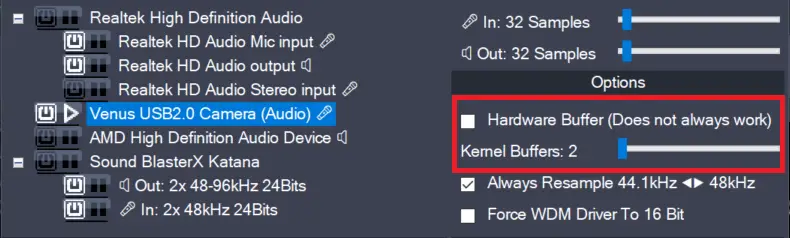
  • Kernel Buffers/Buffer Offset (Obsolete)

    Kernel Buffers/Buffer Offset (Obsolete)

    This feature has been removed in version 2.17!Modern PC hardware does not require multi buffering. This is why the “Kernel Buffers” option has been removed. “Buffer Offset” has changed functionality now and no longer appliues to the “Hardware Buffer” option. If hardware buffering is disabled, this control lets you add up to two more buffers

    more

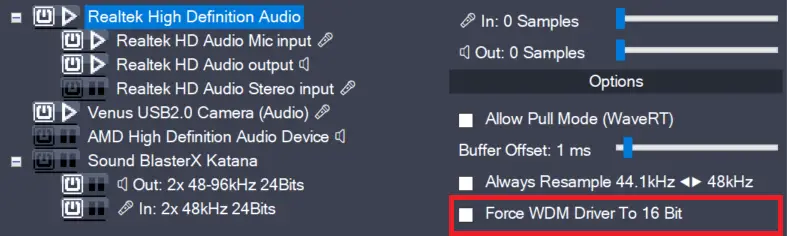
  • Force WDM driver to 16 Bit (obsolete)

    Force WDM driver to 16 Bit (obsolete)

    This feature has been removed in version 2.17!The only purpose it did serve – more than 20 years after its introduction – was to confuse users needlessly. This option only has an effect if the supported bit depth of the WDM driver is larger than 16, but less than 24. Some devices report e.g. 20

    more

  • Common usage cases optimizations

    Common usage cases optimizations

    Becaue it all depends…

    more