

- This version officially supports Windows 10 and Windows 11.
- Also confirmed to work with Windows 7 and Windows 8, with some minor GUI visual artefacts, though.
- Report bugs to feedback@asio4all.com!
Changes since version 2.16:
- Re-wrote large portions of the WaveRT code, thus improving support for not just
various on-board audio solutions. What didn’t work before has a fair chance of working now. - Prevent performance drop when host application window is minimized or fully occluded..
- Remove disconnected BT devices from the WDM device list.
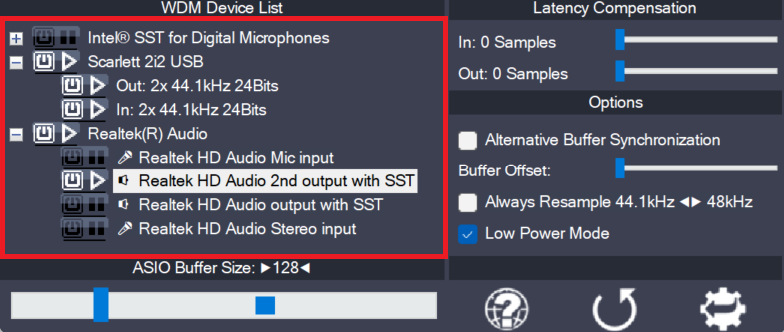
- “Allow Pull Mode” switch has been renamed to “Alternative Buffer Synchronization”, because this is closer to what it does.
ASIO4ALL will pick the WaveRT buffering mode most suitable for any individual device. This checkbox lets you try an alternate mode for better or for worse. - The “Buffer Offset” Slider in the “Options” section now only works per pin. Also, it has become unit-less. The range of the slider represents the entire circular buffer of the current pin, allowing you to apply an offset relative to the audio cursor. Use only to fix crackles due to synchronization errors between devices.
Generally, this slider should remain in its leftmost (default) position, because most of the synchronization work is done automatically. - Fixed numerous other little bugs here and there…
- Known issue: on-board audio input on Lenovo Legion shows “beyond logic”.
IRP_MJ_CREATE for the pin is rejected when not issued by audiodg.exe.
I’m currently at a total loss with this one.
Also, the manual isn’t updated yet.

Comments
12 responses to “Version 2.17 Beta 1”
Si tienen ProTools 12.5 HD o ultimate, está versión me sirvió, espero les sirva.
Hola
Gran aporte de este programa, pero tengo un problema y es que no hay manera de que me deje abrirlo. Me manda a la pagina web
Gracias
That’s correct. However, this microphone slot has high background noise, and the device runs stably on 64-bit but crashes instantly on 32-bit (it crashes right after plugging in). It’s likely that the offline settings also read 32-bit DLLs, leading to the same crash issue. I’ve purchased various USB devices to test ASIO4ALL for this problem.
32-bit ASIO4ALL cannot be launched when USB devices like HS100B and CM108B are connected.
(连接 HS100B、CM108B 等 USB 设备时,32 位版 ASIO4ALL 无法启动。)
Like e.g. one of these? Just making sure…
https://www.amazon.com/dp/B0776QNHKD/
That’s correct. However, this microphone slot has high background noise, and the device runs stably on 64-bit but crashes instantly on 32-bit (it crashes right after plugging in). It’s likely that the offline settings also read 32-bit DLL, leading to the same crash issue. I’ve purchased various USB devices to test ASIO4ALL for this problem.
That’s correct. However, this microphone slot has high background noise, and the device runs stably on 64-bit but crashes instantly on 32-bit (it crashes right after plugging in). It’s likely that the offline settings also read 32-bit DLLs, leading to the same crash issue. I’ve purchased various USB devices to test ASIO4ALL for this problem.
ASIO4All 32-bit will crash when a native 16-bit USB audio device is connected, and I’ve tested this with other USB audio chips and got the same result. It won’t crash if the USB audio chip supports 24-bit.
Confirmed using a 150-year-old SoundBlaster MP3+ 😉
Looking into it…
… nailed it!
Only happening when ASIO4ALL replaces the generic “USB Audio” string with Vendor information based on VID/PID.
Fixed in next release.
Perfect! Thanks so much for confirming and fixing it. Really appreciate your quick work—looking forward to the next release!
Thanks for your advice. I’ve fixed it too—just made it stop searching for the usb\vid string, haha.