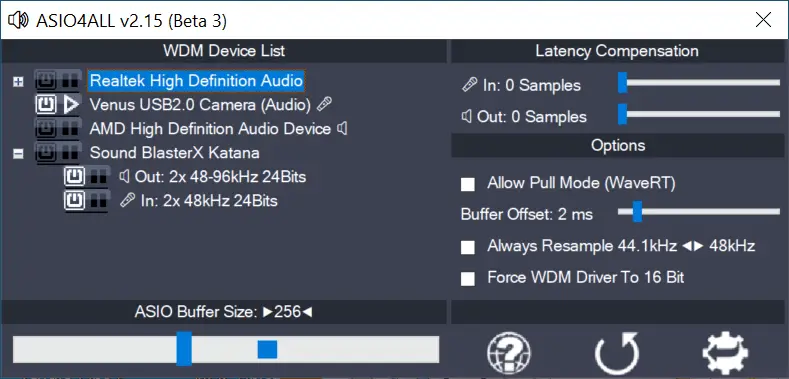
Version 2.15 (Beta 3)

  • This version officially supports Windows 10 and Windows 11. Older versions of the OS may (and likely will) still work, but we no longer claim to be supporting them.
  • Released in all languages currently supported, in order to also spot localization errors.
  • Report bugs to feedback@asio4all.com!

Changes since version 2.15 (Beta 2):

  • Resolve potential Windows 11 compatibilty issues.
  • Fixes and workarounds for on-board audio on newer AMD systems (like Ryzen 5000).
  • Fix a number of issues related to WaveRT packet support.
  • Fix GUI visual distortion on high DPI display.
  • Improve backwards compatibility with Windows 8 (no official support, though!)

Posted

in

,

by

Tags:

Comments

Leave a Reply

Your email address will not be published. Required fields are marked *

This site uses Akismet to reduce spam. Learn how your comment data is processed.

Copyright © Michael Tippach

Imprint | Privacy

Powered by WordPress

ASIO is a trademark of Steinberg Media Technologies GmbH.  All other trademarks are the property of their respective owners, used for product identification purposes only.

  • Advanced configuration

    Advanced configuration

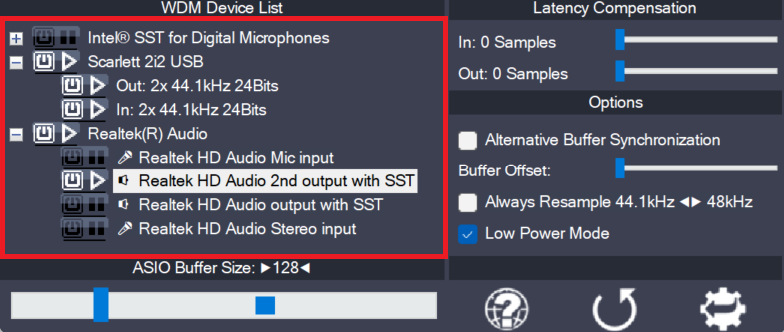
    Once the control panel has been switched to advanced mode, things begin to look a little more complicated. The device list is now expandable and you can enable more than one item at a time. The device list contains Devices, Device Interfaces and so called “Pins”. Devices are independent hardware units most of the time.

    more

  • Device aggregation

    Device aggregation

    Using the button next to each entry, you can now selectively enable/disable each particular item in the device list. This way, you can also create multi-device-setups (“aggregate devices”). Multi-device-setups require that all the devices involved are running from the same clock source. You can achieve this by daisy-chaining devices via S/PDIF etc. On-board devices usually

    more

  • Latency Compensation

    Latency Compensation

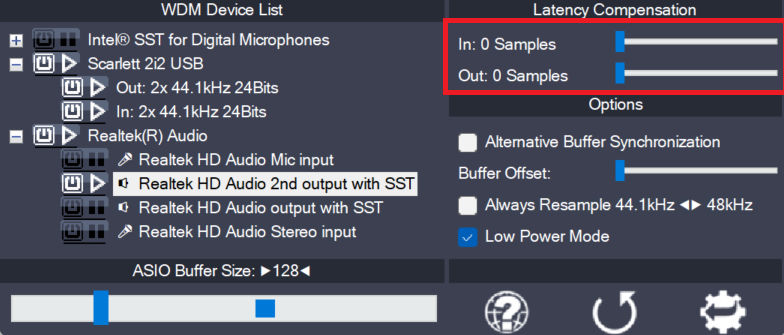
    Since ASIO4ALL does not have sufficient knowledge of the underlying hardware/driver architecture, it can only guess the actual latencies involved. With these sliders you can compensate for the latencies unknown to ASIO4ALL such that recordings in your sequencer Software are properly aligned with the rest. Note: In multi-device-setups the largest respective value of all devices

    more