
Frequently Asked Questions

ASIO4ALL is a free low-latency audio driver that allows users to achieve better audio performance and reduce latency when recording or playing back audio on Windows systems. It provides an ASIO interface for software that supports ASIO drivers.

ASIO stands for Audio Stream Input/Output, a protocol developed by Steinberg that allows for high-performance, low-latency audio recording and playback.

Audio latency is the time delay between when an audio signal is input or output and when it is processed by your computer’s audio system. Higher latency can cause noticeable delays in playback or recording.

ASIO4ALL bypasses the standard Windows audio processing (which can introduce delays) and allows audio to be transferred more directly between hardware and software, resulting in reduced latency.

ASIO4ALL is available for Windows operating systems.

Yes — ASIO4ALL works with most audio applications that support the ASIO protocol.

Yes — ASIO4ALL can be used with many built-in computer audio devices and external interfaces.

Yes — ASIO4ALL is straightforward to install and use. After installation, select it as your ASIO driver in your audio software and configure device settings in the driver control panel.

Yes — ASIO4ALL runs only when an ASIO host application uses it and does not overwrite or replace any other system components.

No — ASIO4ALL is free to download and use for end users, including for commercial purposes.
Copyright © Michael Tippach

Imprint | Privacy

Powered by WordPress

ASIO is a trademark of Steinberg Media Technologies GmbH.  All other trademarks are the property of their respective owners, used for product identification purposes only.

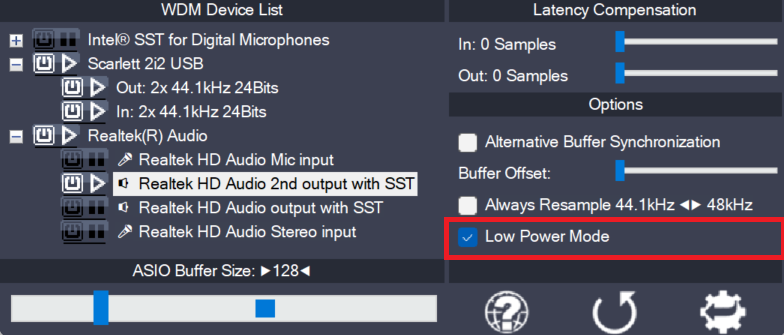
  • Low Power Mode

    Low Power Mode

    This is a global option – for the current audio host application – telling the ASIO4ALL main audio thread how to spend its idle time, i.e. the time when not calling the DAW audio processing handler. The default for this option is “enabled”, potentially lowering CPU utilization in idle mode. Depending on the current ASIO4ALL

    more

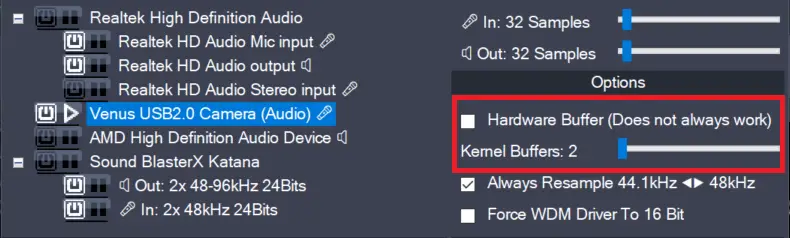
  • Hardware Buffer on/off (Obsolete)

    Hardware Buffer on/off (Obsolete)

    This feature has been removed in version 2.17!The only purpose it did serve – more than 20 years after its introduction – was to confuse users needlessly. Enables the hardware buffer for the highlighted device. This only works for so called “WavePCI” miniports, as other types of WDM drivers do not usually allow direct access

    more

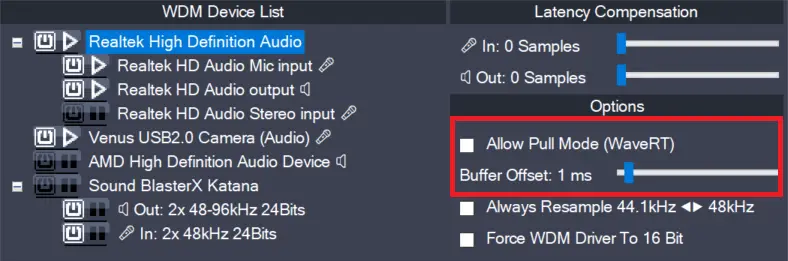
  • Allow Pull Mode (WaveRT) (obsolete)

    Allow Pull Mode (WaveRT) (obsolete)

    In version 2.17, this feature has been replaced by the “Alternative Buffer Synchronization” – option! There are two basic access methods for a WaveRT device, “pull-mode” (also called “event-mode”) and “push-mode” (also called “polling mode”). If this box is left unchecked, ASIO4ALL will not use “pull-mode”, otherwise it will use it whenever possible. The default

    more