Version 2.8 (Final) Released!

– Note that more localizations may be added as soon as I get in sync with folks who volunteered! –

Changes since version 2.8 beta 2:

  • No longer faults with SB X-Fi under Vista.
  • General Vista compatibility improved.
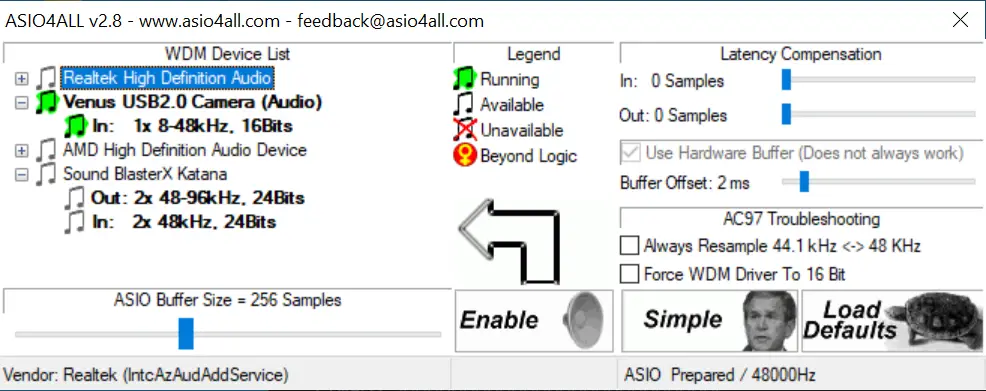
  • Improved WDM enumerator display of device names.
  • Add ability to recover from surprise removal of USB audio devices.
  • Some fine tuning of WaveRT implementation.
  • Agressive device re-ordering (as of beta 2) softened down somewhat. Analog outputs should still be listed before SPDIF ones, though.
  • More minor improvements, most of which mainly serve to increase fault tolerance, others may change the world as we know it, but, alas, over time I had forgotten which ones and in what way exactly.
Posted

in

,

by

Tags:

Comments

Leave a Reply

Your email address will not be published. Required fields are marked *

This site uses Akismet to reduce spam. Learn how your comment data is processed.

Copyright © Michael Tippach

Imprint | Privacy

Powered by WordPress

ASIO is a trademark of Steinberg Media Technologies GmbH.  All other trademarks are the property of their respective owners, used for product identification purposes only.

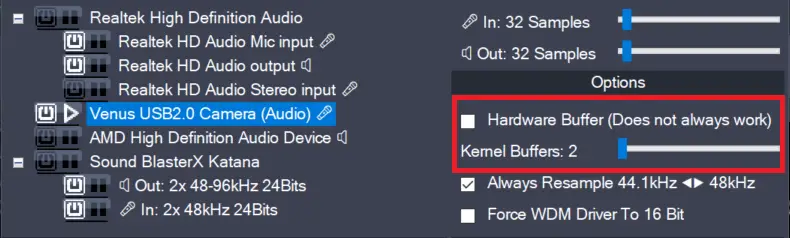
  • Kernel Buffers/Buffer Offset (Obsolete)

    Kernel Buffers/Buffer Offset (Obsolete)

    This feature has been removed in version 2.17!Modern PC hardware does not require multi buffering. This is why the “Kernel Buffers” option has been removed. “Buffer Offset” has changed functionality now and no longer appliues to the “Hardware Buffer” option. If hardware buffering is disabled, this control lets you add up to two more buffers

    more

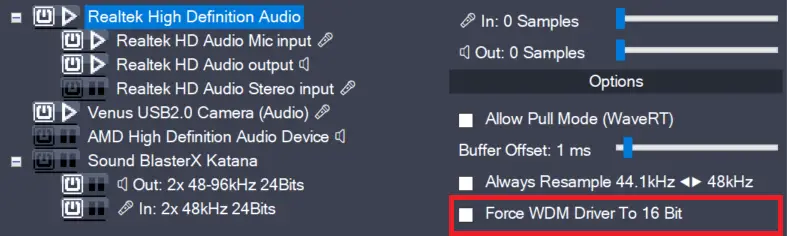
  • Force WDM driver to 16 Bit (obsolete)

    Force WDM driver to 16 Bit (obsolete)

    This feature has been removed in version 2.17!The only purpose it did serve – more than 20 years after its introduction – was to confuse users needlessly. This option only has an effect if the supported bit depth of the WDM driver is larger than 16, but less than 24. Some devices report e.g. 20

    more

  • Common usage cases optimizations

    Common usage cases optimizations

    Becaue it all depends…

    more