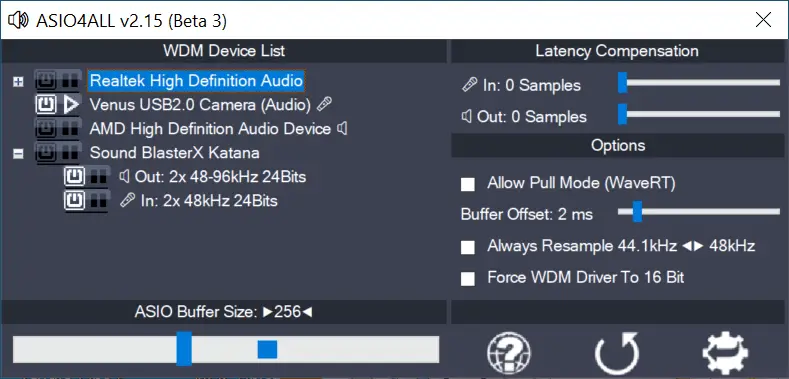
Version 2.15 (Beta 3)

  • This version officially supports Windows 10 and Windows 11. Older versions of the OS may (and likely will) still work, but we no longer claim to be supporting them.
  • Released in all languages currently supported, in order to also spot localization errors.
  • Report bugs to feedback@asio4all.com!

Changes since version 2.15 (Beta 2):

  • Resolve potential Windows 11 compatibilty issues.
  • Fixes and workarounds for on-board audio on newer AMD systems (like Ryzen 5000).
  • Fix a number of issues related to WaveRT packet support.
  • Fix GUI visual distortion on high DPI display.
  • Improve backwards compatibility with Windows 8 (no official support, though!)
Posted

in

,

by

Tags:

Comments

Leave a Reply

Your email address will not be published. Required fields are marked *

This site uses Akismet to reduce spam. Learn how your comment data is processed.

Copyright © Michael Tippach

Imprint | Privacy

Powered by WordPress

ASIO is a trademark of Steinberg Media Technologies GmbH.  All other trademarks are the property of their respective owners, used for product identification purposes only.

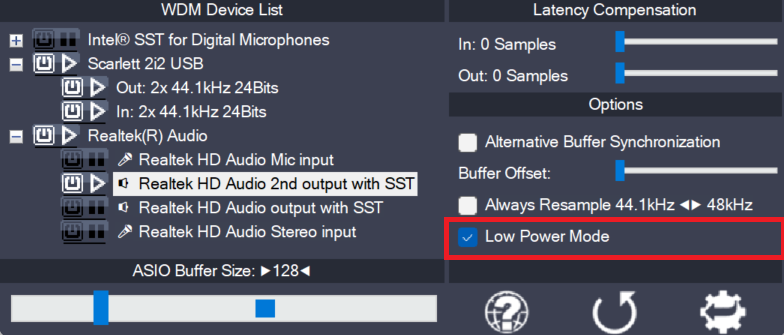
  • Low Power Mode

    Low Power Mode

    This is a global option – for the current audio host application – telling the ASIO4ALL main audio thread how to spend its idle time, i.e. the time when not calling the DAW audio processing handler. The default for this option is “enabled”, potentially lowering CPU utilization in idle mode. Depending on the current ASIO4ALL

    more

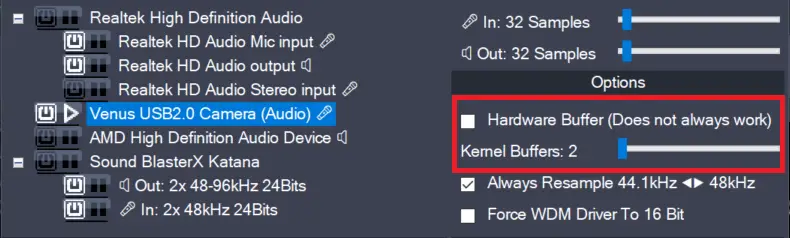
  • Hardware Buffer on/off (Obsolete)

    Hardware Buffer on/off (Obsolete)

    This feature has been removed in version 2.17!The only purpose it did serve – more than 20 years after its introduction – was to confuse users needlessly. Enables the hardware buffer for the highlighted device. This only works for so called “WavePCI” miniports, as other types of WDM drivers do not usually allow direct access

    more

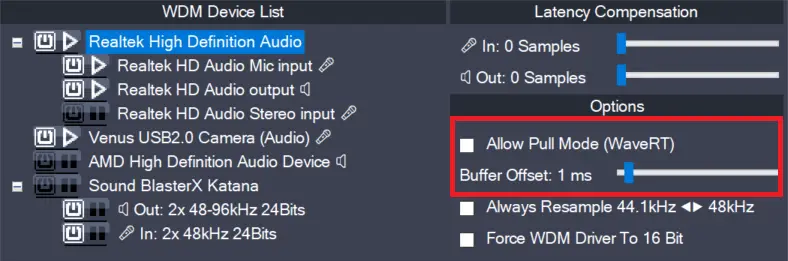
  • Allow Pull Mode (WaveRT) (obsolete)

    Allow Pull Mode (WaveRT) (obsolete)

    In version 2.17, this feature has been replaced by the “Alternative Buffer Synchronization” – option! There are two basic access methods for a WaveRT device, “pull-mode” (also called “event-mode”) and “push-mode” (also called “polling mode”). If this box is left unchecked, ASIO4ALL will not use “pull-mode”, otherwise it will use it whenever possible. The default

    more